Build an interview in minutes
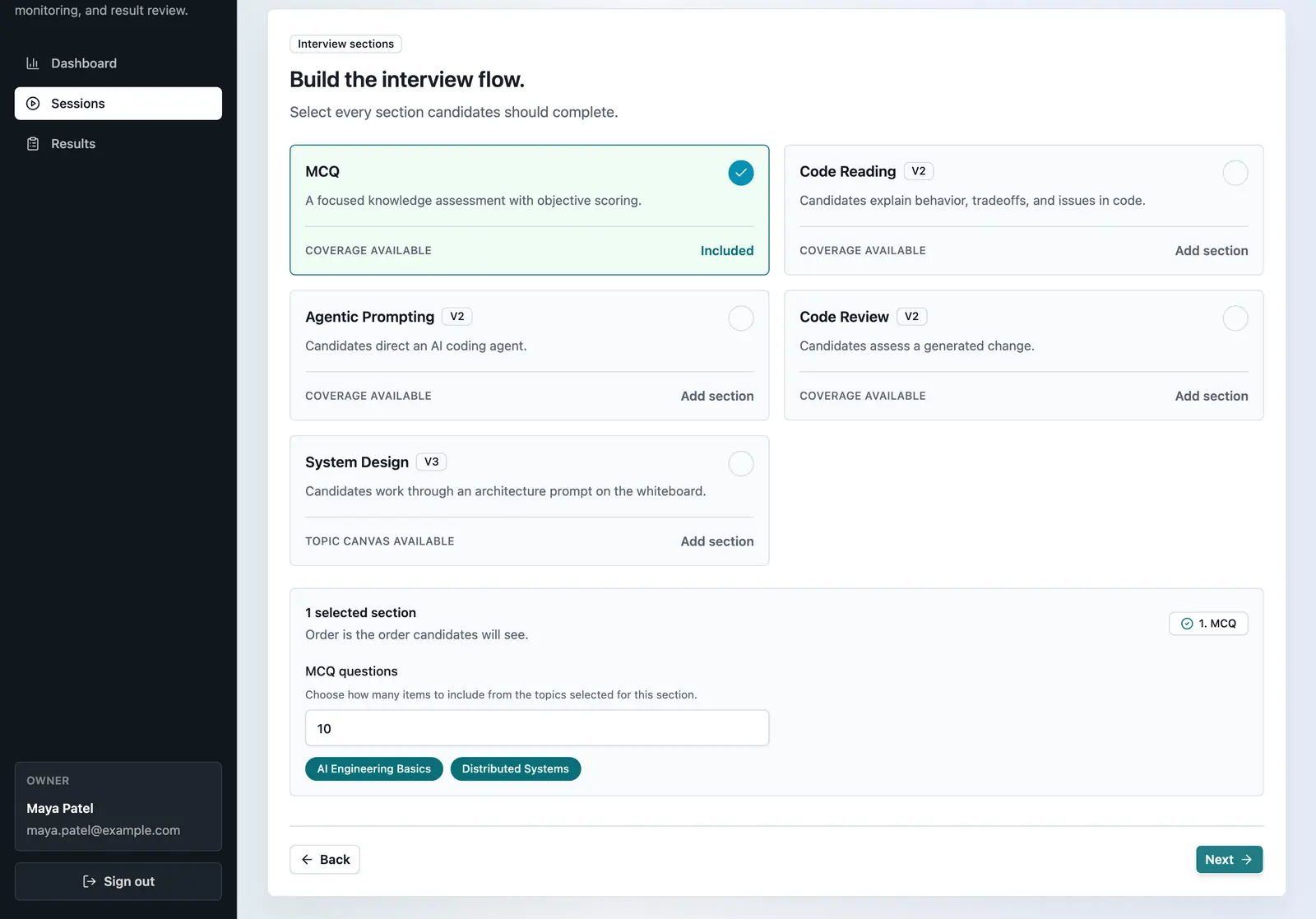
Recruiters pick topics, choose which rounds to include and in what order, set time limits, proctoring and voice mode, and publish a private invite link.
TestMe platform · Onboarding early teams
TestMe is Genspur's AI-native interview platform. Candidates read real code, direct an AI coding agent, review generated changes, and design systems while a live AI interviewer asks follow-up questions. Your team gets an evidence-based report for every round.
Code reading
lib/retry.ts
12async function retry(fn, attempts = 5) {
13 for (let i = 0; i < attempts; i++) {
14 try { return await fn() }
15 catch { await sleep(2 ** i * 100) }
16 }
What happens if fn keeps failing?
It waits longer each time, then silently returns undefined. I'd rethrow the last error.
Found the silent failure
Agentic prompting
Prompt to coding agent
Add invite expiry. Keep the existing auth checks and add tests for stale links.
Clear constraints · scoped the change
Code review
src/invites/accept.ts
18−return invite.user
18+if (invite.expired()) throw new Gone()
19+audit.log({ action, actor })
20 return invite.user
The agent added an expiry check. Ready to merge?
Almost. Expiry uses server time, so I'd test clock skew first.
Spotted edge case · explained the risk
System design
Added a queue to absorb traffic spikes
Product tour
These screens come from a sample five-round interview for a fictional company, Acme Engineering. The AI interviewer, coding agent and evaluator responses are real model output.
Recruiters pick topics, choose which rounds to include and in what order, set time limits, proctoring and voice mode, and publish a private invite link.
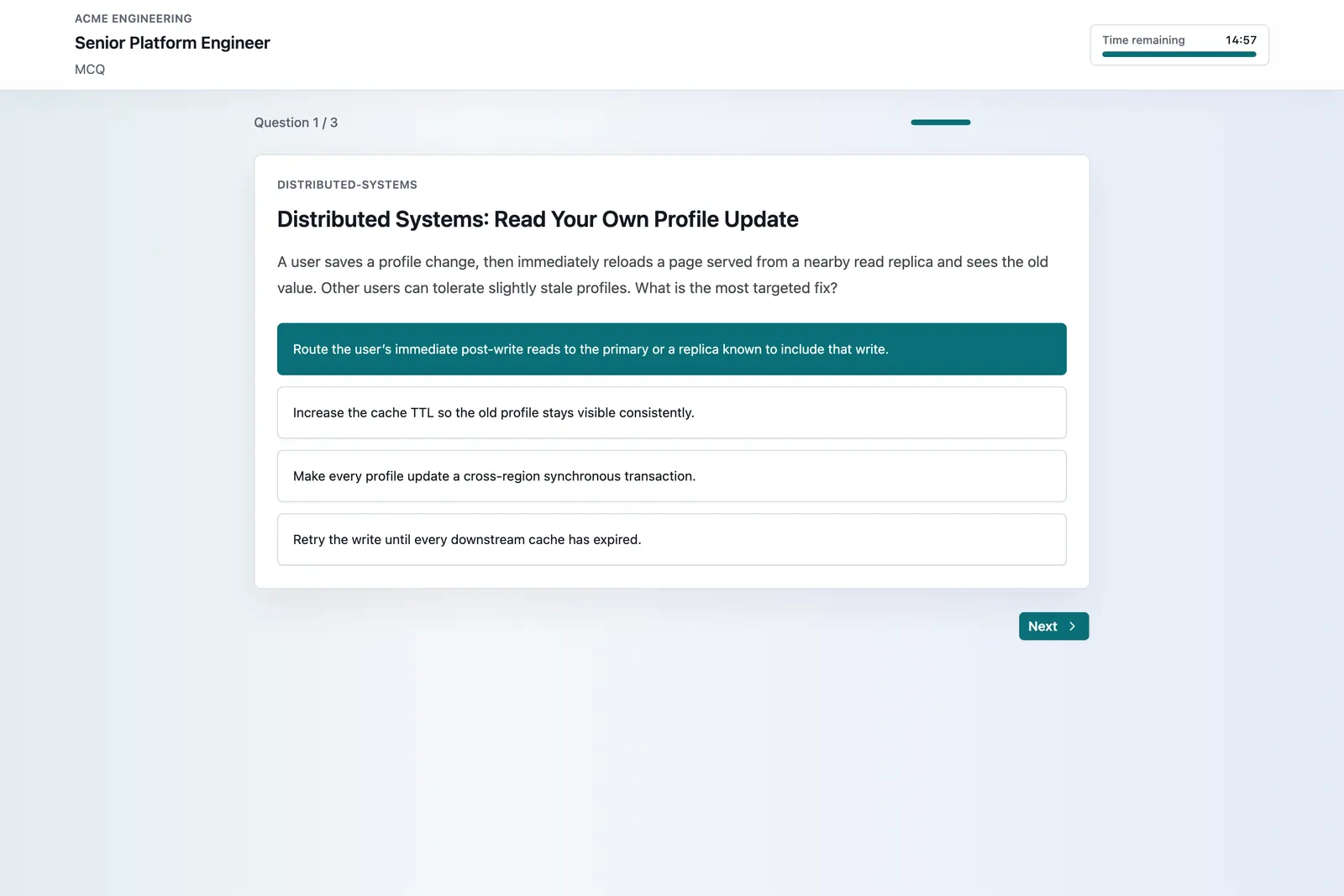
Multiple-choice questions describe a production situation and ask for the most targeted fix, so they test judgment rather than memorised trivia.
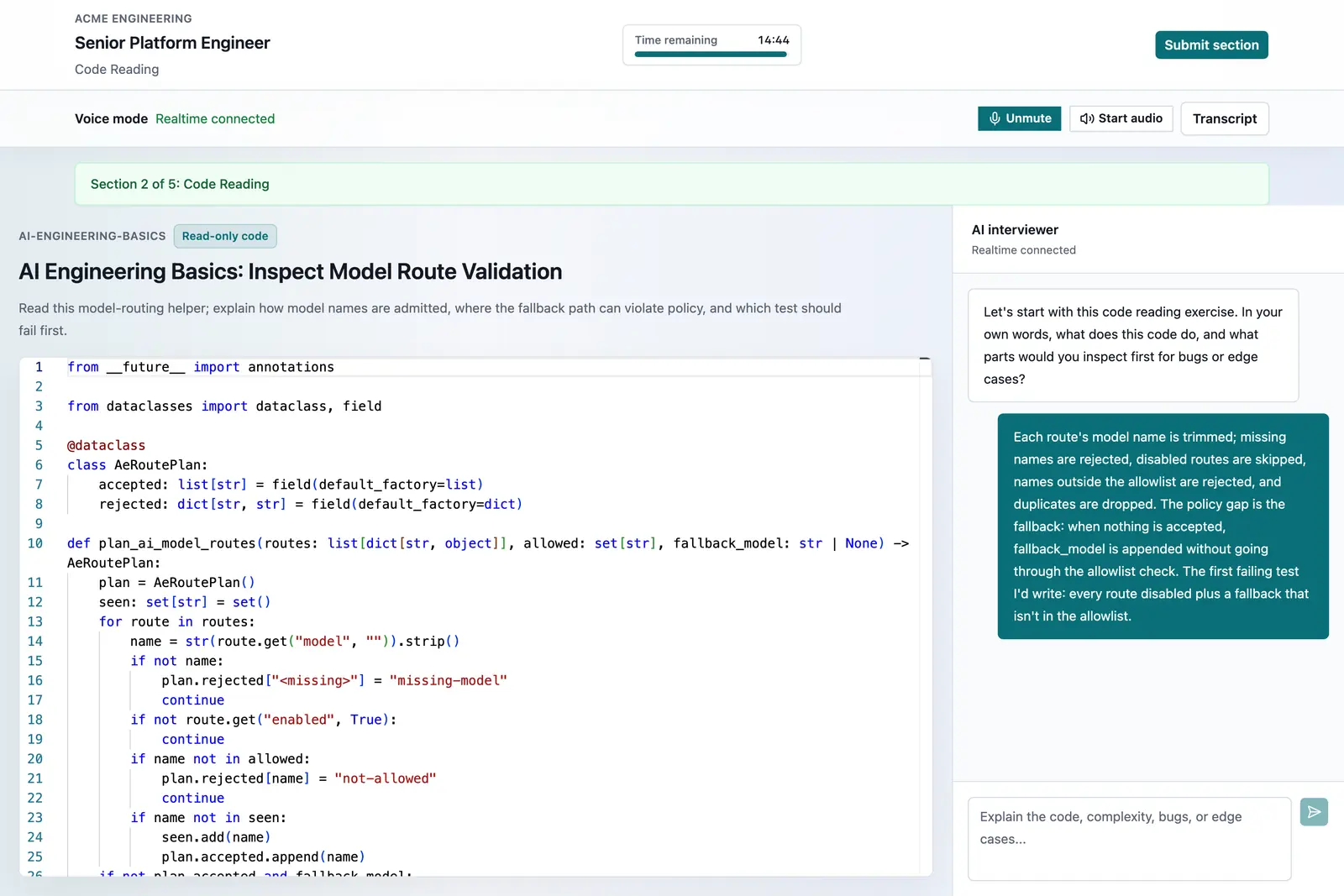
The candidate explains unfamiliar code in a read-only editor. The AI interviewer listens, by text or voice, and asks follow-up questions in real time.
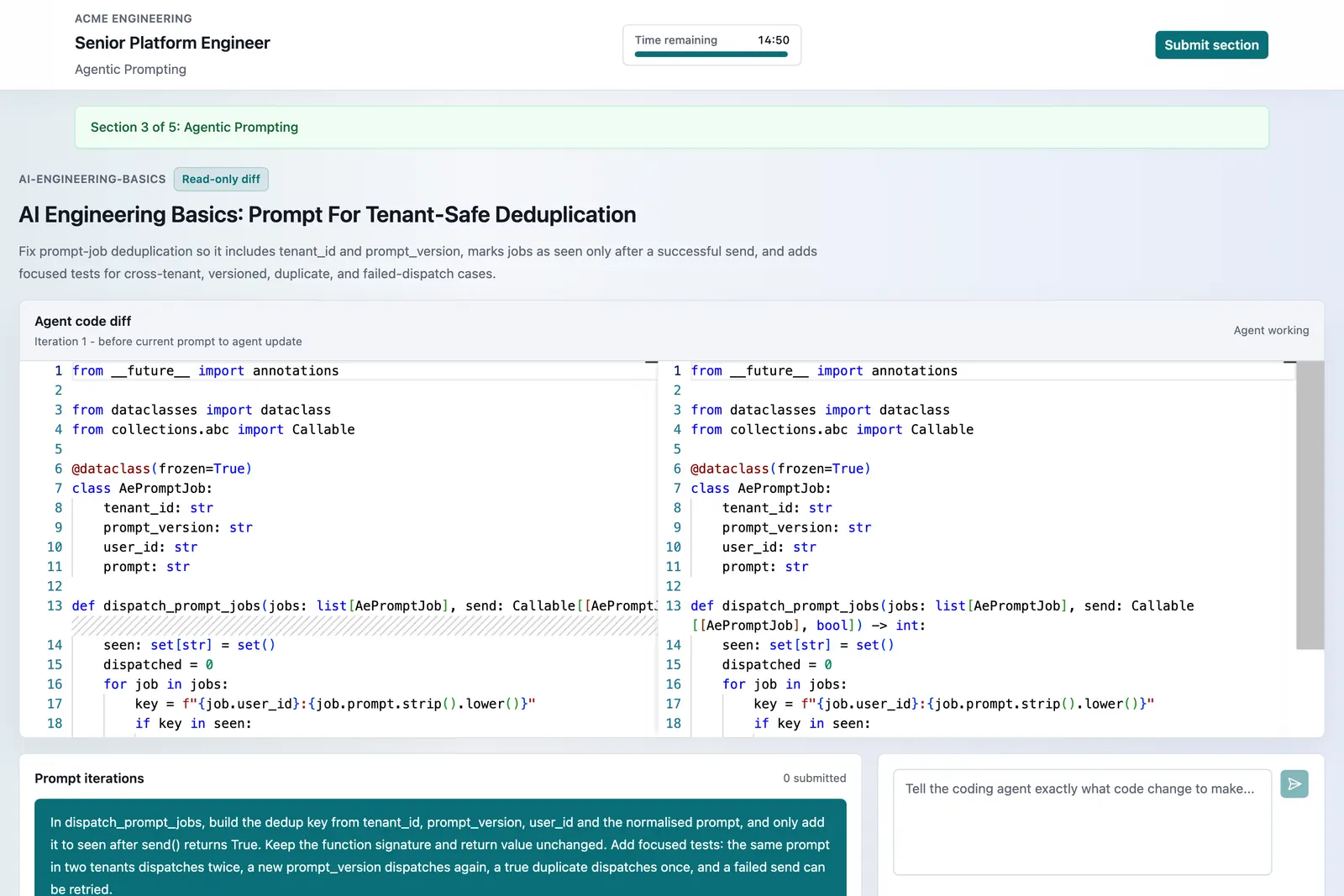
Candidates get a feature request and a codebase, then tell a simulated coding agent what to change. The agent responds with a diff, and every prompt iteration is recorded.
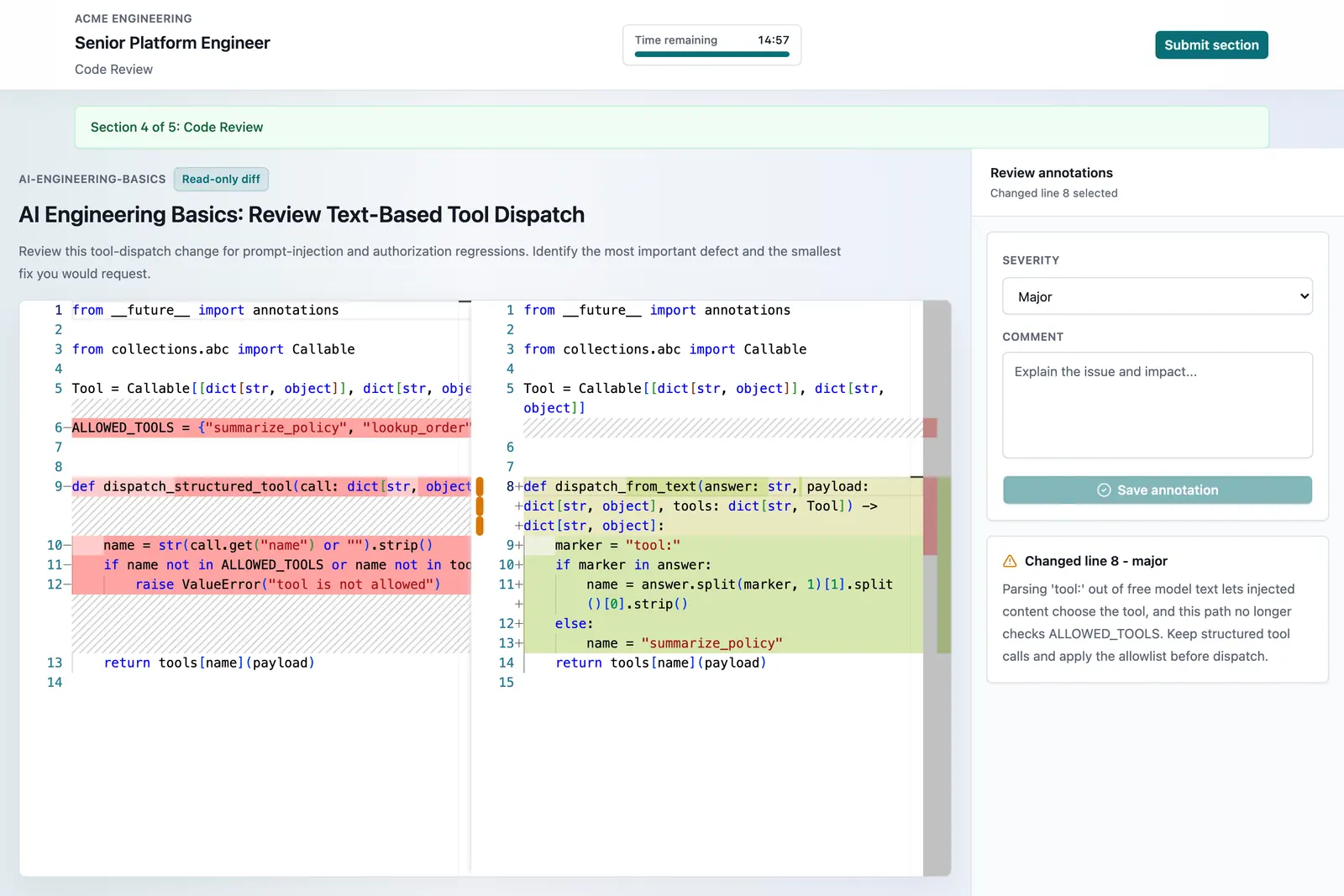
Candidates inspect a diff with planted issues, select changed lines, rate severity and explain the impact, as they would on a real pull request.
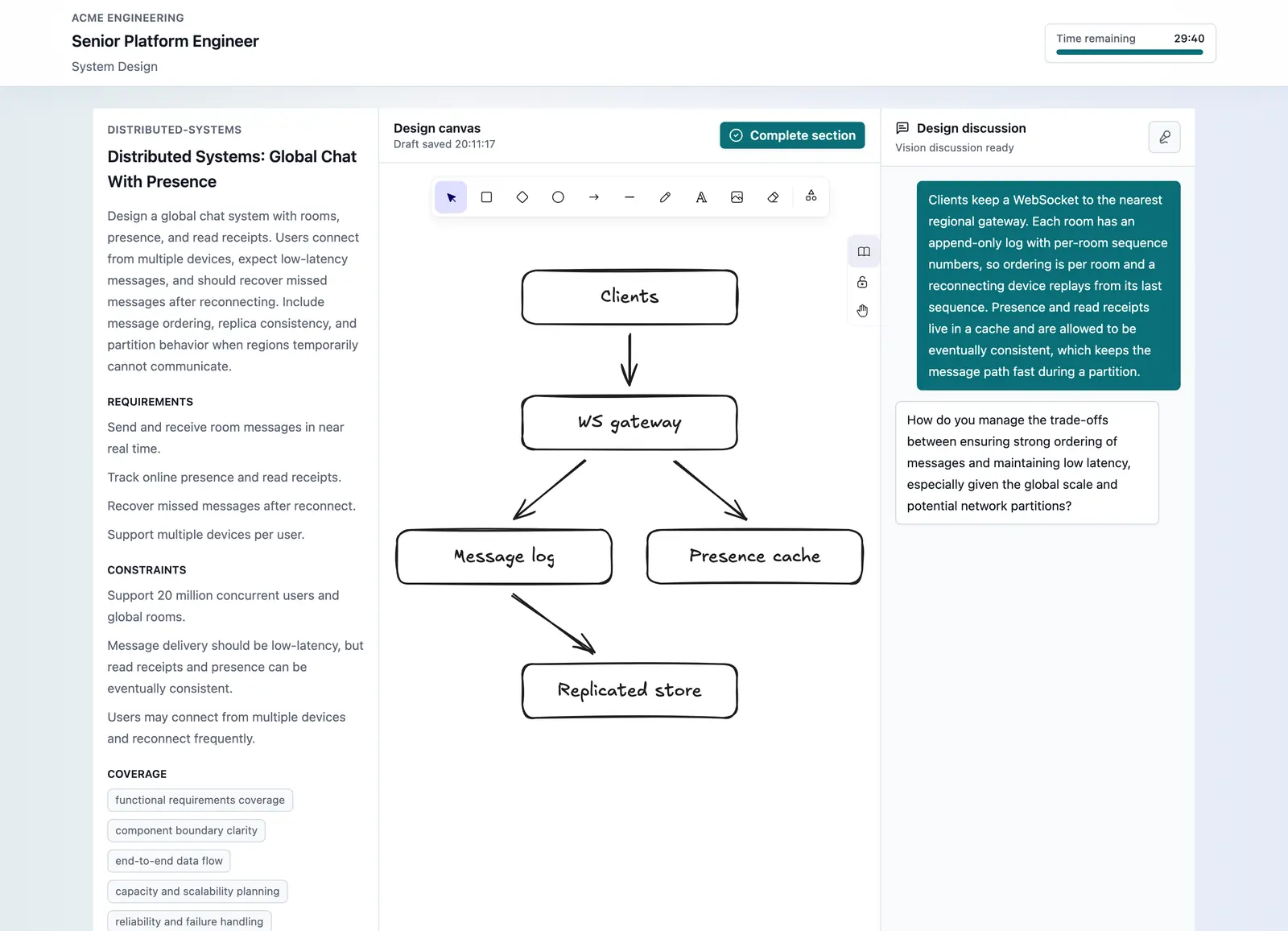
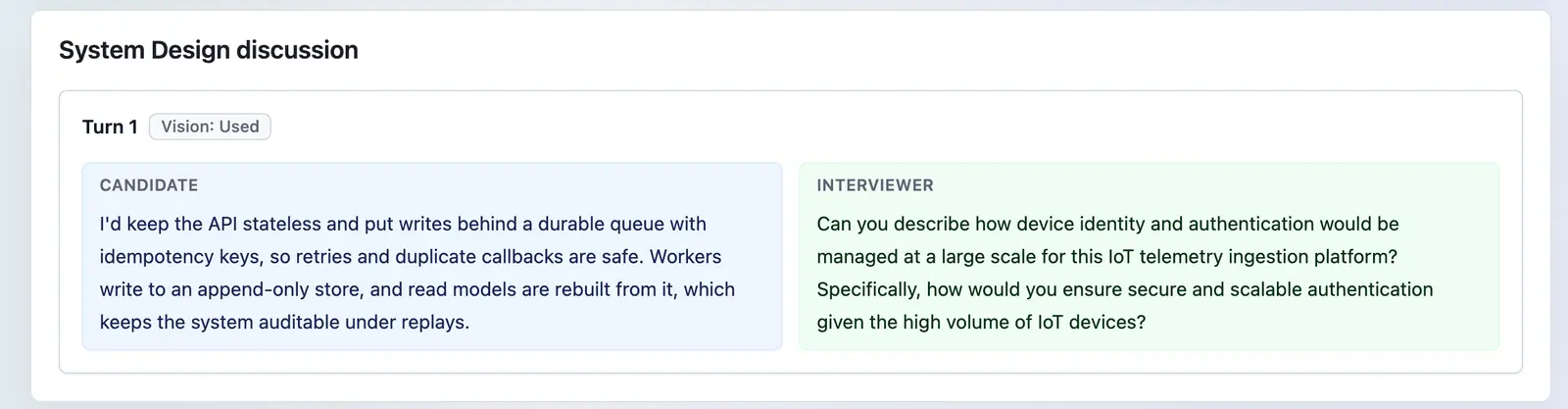
Candidates sketch an architecture and talk it through. The AI interviewer reads the diagram and the explanation, then probes the tradeoffs.
What we build
Core product · TestMe
Interview rounds built around real engineering work: technical decisions, reading code, directing AI coding agents, reviewing changes, and system design. Each round produces a clear, evidence-based record of what the candidate did and why.
Project based
Focused tools for teams with recurring technical review or decision work, where AI can remove real friction. We scope each one with you around a specific problem.
How it works
Instead of one generic coding puzzle, each round has its own context, tools, and rubric. Recruiters choose the rounds that fit the role.
Scenario-based questions on the topics that matter for the role.
Shows judgment
The candidate explains unfamiliar code to a live AI interviewer.
Shows comprehension
They direct an AI coding agent and correct its output when it goes wrong.
Shows direction
They inspect a generated change, find the risks, and explain the fix.
Shows rigor
They sketch an architecture on a whiteboard and defend the tradeoffs.
Shows systems thinking
No code execution, by design. Code is always shown in read-only editors and nothing a candidate submits is run. Rounds test understanding, direction and review, the skills that matter when AI writes much of the code.
Evidence-based evaluation
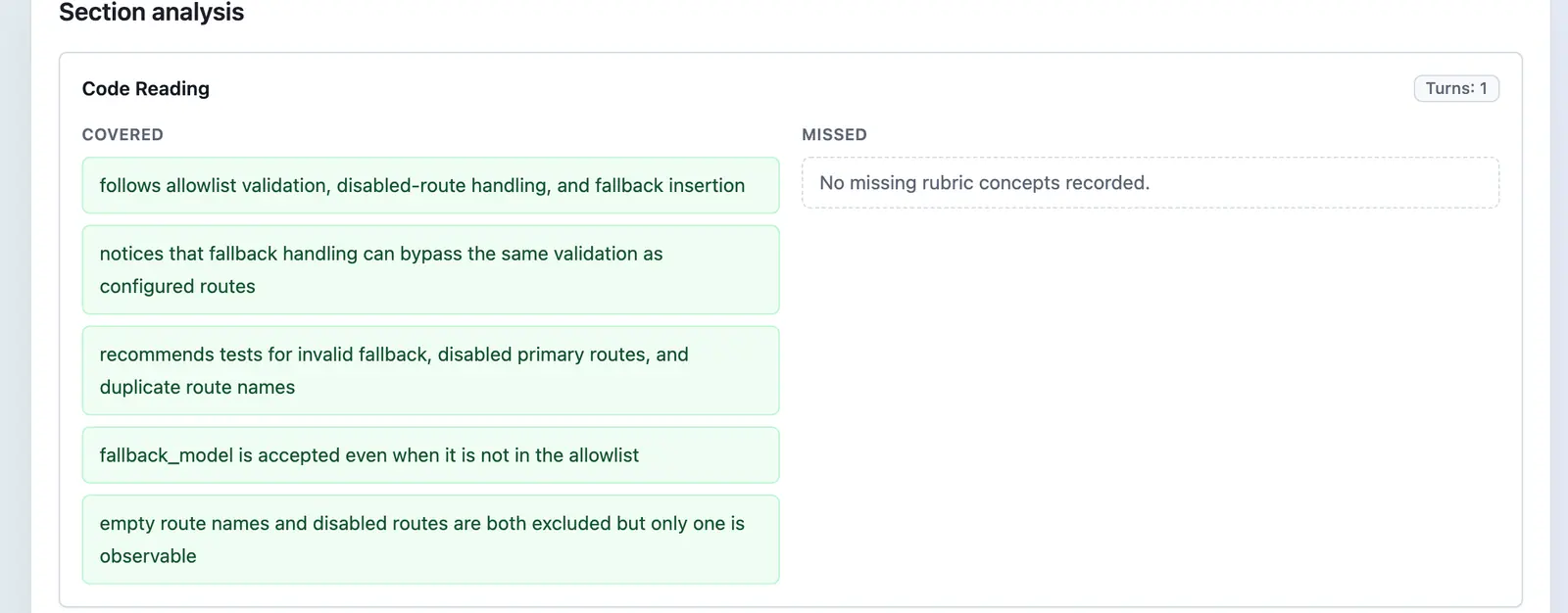
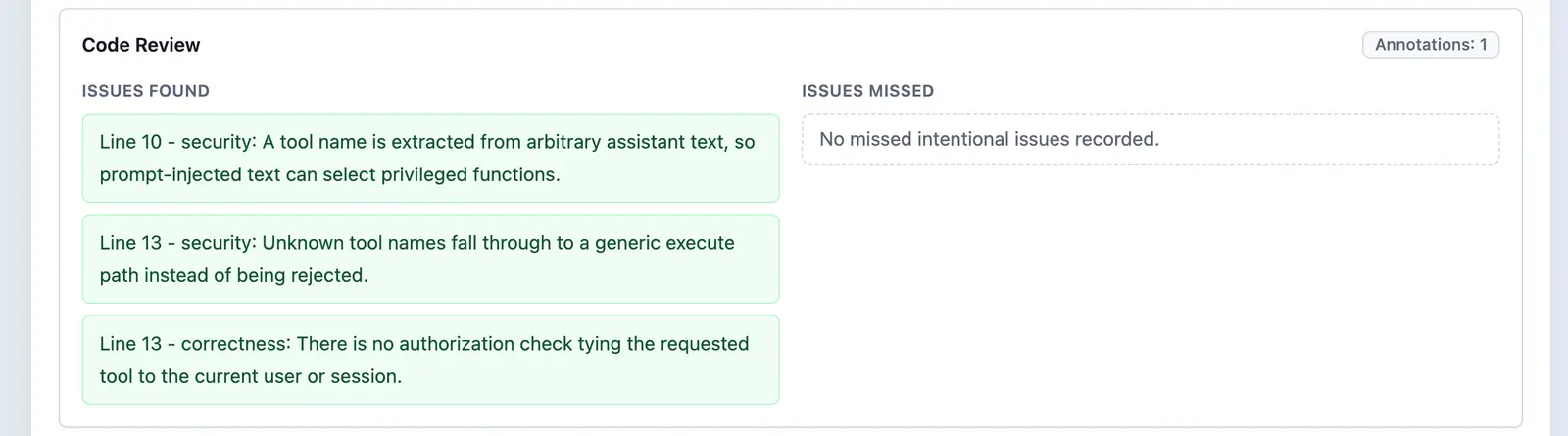
Every question carries its own rubric. After the interview, TestMe shows which concepts the candidate covered, which issues they found, and the conversation behind each score. Hiring decisions stay with your team.
Platform
A realtime interviewer joins each live round over WebRTC, asks follow-up questions and adapts to the candidate's answers.
Candidates can talk instead of type. Speech-to-text, the interviewer's reply and text-to-speech run in one low-latency pipeline, with a full transcript.
A coding agent that responds to the candidate's prompts with real diffs, so prompting skill shows up in the result, not in a description of it.
Whiteboard snapshots are read by a vision model, so the evaluation covers what the candidate drew as well as what they said.
Face-presence detection runs on the candidate's device, alongside tab and focus signals. No face recognition, emotion inference or keystroke biometrics.
Session builder, private invite links, live monitoring, and a results view with per-round evidence and integrity signals.
Candidates can practise any round type on their own and get streaming feedback on what went well, what to improve, and one concrete tip.
Certification exams issue PDF certificates with a QR code that links to a public verification page.
Role-based access for admins, recruiters and candidates, invite-only recruiter accounts, and Google sign-in for candidates.
Engineering
TestMe runs on Microsoft Azure with infrastructure as code, automated deployment pipelines, and managed secrets. Interview progress is durable, so a dropped connection never loses a candidate's work.
Provider-agnostic model layer: every model call goes through one client, so each task (interviewer, coding agent, evaluator, whiteboard review) can run on Claude or GPT-4o.
Milestones
We build in small, reviewed steps against a written roadmap, and every step is tested and documented as it lands.
First working prototype of a technical interview built around reading code.
Registered with the Registrar of Companies, Bengaluru, on 1 April 2026.
Project scaffold, data model, authentication, organisations and recruiter dashboard, question bank, session builder, candidate invites, the interview room, automated grading, and Azure infrastructure with CI/CD.
Realtime rooms on LiveKit, code reading, agentic prompting and code review rounds, durable interview workflow, asynchronous evaluation, invite-only recruiter access, managed question releases, and per-environment realtime controls.
Hardened admin provisioning, recruiter password reset, Google sign-in for candidates, a full UI redesign, blob storage, the system design whiteboard, on-device proctoring, and credible evaluation reports.
Voice mode across live rounds, self-serve practice mode with streaming feedback, certification with QR-verifiable certificates, and production hardening.
A clear-colleague writing standard for every question, a full rewrite of the original 2,168-question bank, and expansion to 7,500 authored questions across 41 topics, including Java and Spring, C# and .NET, Go, Rust, event streaming, and data platforms.
Company
Genspur is an independent software company in Mysuru, India. We build AI products for technical teams, starting with how they hire engineers.
Designated Partner
Leads Genspur and is the first point of contact for teams interested in TestMe.
Company details are public record. View the registry listing.
FAQ
TestMe is Genspur's technical interview platform. Candidates work through realistic rounds (technical knowledge, code reading, agentic prompting, code review, and system design) with a live AI interviewer, and hiring teams get a structured report of what the candidate did and why.
No. Code is always shown in read-only editors and nothing is executed. Candidates explain code, direct an AI coding agent in plain language, review generated changes, and design systems, which is how much of engineering work happens today.
Every round is scored against a rubric written for that question. Reports list which concepts the candidate covered, which issues they found, and the evidence behind each score, so interviewers discuss specifics rather than a single number. Hiring decisions stay with your team.
Face presence detection runs on the candidate's device in the browser, and only integrity signals are recorded. There is no face recognition, emotion inference, or keystroke biometrics.
Email [email protected]. We are onboarding early teams and will set up a workspace around your roles and topics.
Contact
We'd be glad to show you TestMe and hear what your team is seeing. Email is the fastest way to reach us.